Posts filed under Technology
Dual Core NVIDIA Tegra2 chip even faster than the Snapdragon
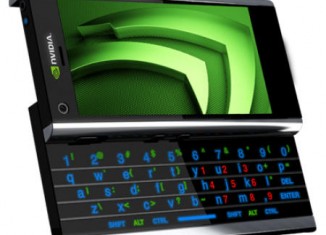
Forgive the continued teccie-ness, but straight after posting about the new dual-core Snapdragon chip promised for the end of 2010 comes news of NVIDIA’s new next-gen Tegra2 chip for smartphones, which blows the Snapdragon clean out the water!
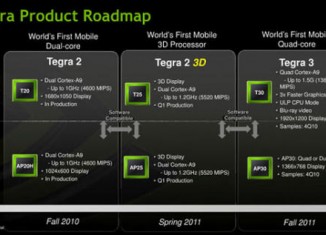
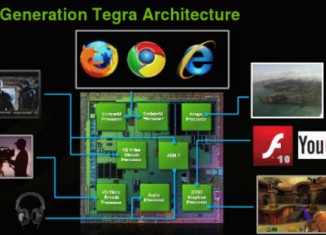
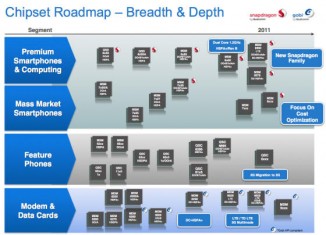
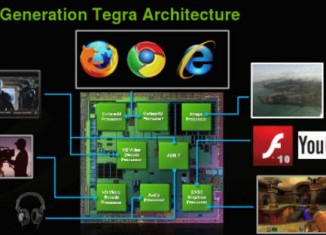
Qualcomm’s next gen Snapdragon will be dual core and run at speeds of 1.5GHz. NVIDIA’s nexyt gen Tegra2 will also be dual-core, but although it only runs at 1GHz, it contains no less than eight independent processors, each of which is dedicated to tasks such as Web browsing, mobile 3D gaming and HD video.
What this gives you is a smartphone chipset that’s 10 times faster than anything on the market today. And unlike the Qualcomm chips, NVIDIA actually have the Tegra2 in production, and in the hands of gadget developers now!
Expect it to surface on Internet tablets first, followed swiftly by smartphones.
Phew! I think Google’s right. This really is the age of the superphone!
[Source: Engadget]
Super-fast gigahertz phones arrive from NVIDIA, Samsung and Toshiba
After reading our HTC Hero review earlier, you might be under the impression that mobiles are going the way of Windows – super-functional, but bogged down with bloat that makes them sluggish.
Not a bit of it! There’s no less than three super-charged mobile processors about to come on stream leading to a new age of GHz mobile phones that are super-fast, super-responsive, and which pack some stunning new features. The likes of Samsung, Toshiba and HTC are just some of the mobile phone manufacturers leading this race, with graphics specialist NVIDIA also helping out.
Here’s a run down of these new technologies, and a sneak preview at some of the phones that are coming that will make any handset you currently own look like a creaking old truck!
Intel working on battery-free mobile phones
Interesting news reaches us from sister-site MediaMentalism of new technology being developed by Intel that could lead to the development of mobile phones and other mobile and portable gadgets that don’t need batteries. Intel are working on a series of sensors that can capture energy from the environment.
The sun is an obvious example of where this energy comes from, but other examples that Intel are looking at include the motion of a trackball on a mobile phone and even the energy from a mobile phone basestation.
More info over at MediaMentalism.
Google turns mobile phones into remote controls

Our sister-site MediaMentalism.com, which is undergoing something of a renaissance (“about time,” somebody shouted!) has news of a new Google app that enables a mobile phone to stream music, pictures and videos between your PC and any suitably-equipped home device such as your TV or Hi-Fi.
You can use your phone to select videos from your PC, and then wirelessly stream them onto your TV, all via the comfort of your armchair. Effectively, your mobile phone becomes your new remote control.
Of course, not all mobile phones are capable of doing this, but a surprising number are. Read on for more details of what’s involved.
Samsung reinvents the camera phone
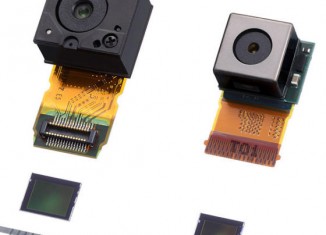
It seems camera phones are about to get a whole lot better, at least if Samsung has any say in the matter. What you see here is the company’s latest technological miracle: an 8 megapixel CMOS sensor designed exclusively for camera phones. As you can see, it’s pretty small – just 28mm x 15.3mm x 8.5mm – but most impressive is the functionality it provides. Not only does it come with 8 megapixels, it also offers ISO settings up to 1600, which means pics taken in low light conditions will look much better.
There also anti-shake technology built-in, face recognition, a 1cm macro, and Samsung’s very own “Smile shutter” system, which detects smiles, and automatically takes a photo when everyone is smiling! Not entirely sure why you’d want a photo album filled with grinning idiots, but at least it beats a set of gurning ghouls, which my Facebook photos seem to consist of!
The new Samsung CMOS will begin production in the third quarter of this year, so expect to see 8 megapixel camera phones based on this chip early in 2009.
[Source: TrustedReviews]
Philips folding screen phone on its way for 2008
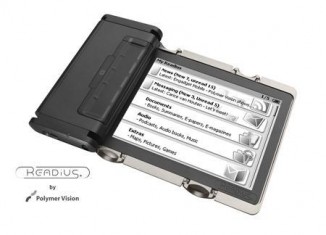
Philips’ spin off Polymer Vision has been showing off its READIUS screen for over two years now, but nothing has emerged beyond prototype form. For those unaware of the READIUS, it’s an innovative new display technology that enables the development of a completely foldable screen.
Now, though, they’ve just issued a press release stating that a new mobile phone made by Philips (who own 25% of Polymer Vision) will soon be released that will be the first phone in the world to feature one of Polymer Vision’s amazing five inch foldable screens.
“Hang on,” I hear you cry, as the penny slowly starts its descent. “Five inch screen…foldable? You mean a huge mobile phone screen that folds up into a super-slim form factor when not in use? Just like paper?”
Yes – and it’ll finally be released mid-2008!
More pics of the Philips READIUS mobile phone after the jump.
CES 2008: World’s fastest GPS phone on show
It wasn’t just the big 5 mobile phone makers who were showing off their wares at CES this year. Completely unheard of Much smaller companies were also showing off their technology. Companies such as dMedia, or as they’re better known: “who?!”
OK, so you may not have heard of them, but what they had to show was pretty nifty: not just the world’s fastest GPS phone, but the world’s fastest GPS phone with dual screens!
Samsung 8 megapixel camera phones on their way in 2008
Samsung have announced brand new technology that will see them mass-produce 8 megapixel camera phones complete with auto-focus in the first half of 2008. Currently, mid-range phones mostly feature a 3.2 megapixel camera, while the high-end phones, such as the Nokia N95 and Sony Ericsson K850i feature 5 megapixels.
Although other phones have offered high megapixellage (Samsung famously released a 10 megapixel monster back in 2006 in Korea, for example), this is the first time a major handset manufacturer has committed itself to extremely high megapixels for the mass market.
More details after the jump.
Google’s Android turns into underpants

Finally, all the hype and speculation surrounding Google’s mobile phone plans can be put to rest, as the company has announced its mobile strategy. As expected, there is no Google gPhone; rather, we get Google’s Android, an “open and comprehensive platform for mobile devices” that includes operating system, user interface and applications.
Google also announced the Open Handset Alliance, a consortium of big mobile phone companies and operators (including HTC, Motorola, Qualcomm, Samsung, Telefonica, Sprint Nextel and T-Mobile) who are currently working on developing Android-based phones and services.
So, should existing phone manufacturers be worried by Android? And more importantly, should we be excited by what’s on offer? Read on…
Nokia Research’s futuristic vision for camera phones
Nokia has been showing off some of the R&D it does at its Nokia Research Centre at its The Way We Live Next show in Finland. One of the most amazing services it was keen to talk about was its Point&Find solution, which literally links the real world to the virtual world via your camera phone.
The concept is simple. Wherever you are in the real world, you’ll see objects that you’ll want more information about, such as film posters, books, statues, restaurants, etc. You might want more details of a film being advertised on a poster, for example, or find out why a statue was created, or even how good a restaurant’s food is.
Nokia’s Point&Find solution lets you find this out with your camera phone instantly.
See how after the jump.